2026 Ultimate Guide to Cost Savings for Carton Packaging
In-depth Cost Reduction Strategies from Structural Engineering to Supply Chain Collaboration
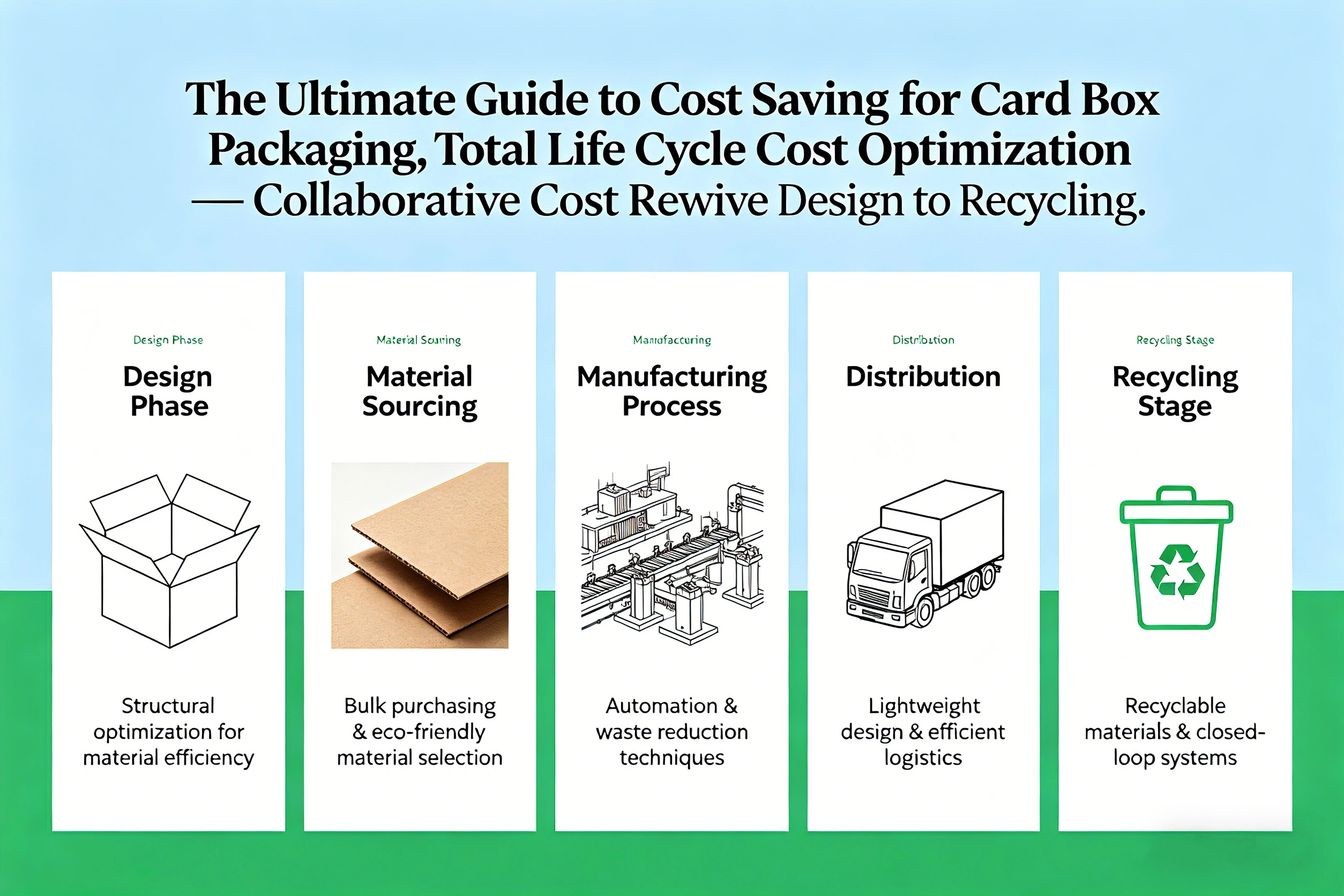
Executive Summary (Too Long; Didn't Read)
Packaging cost can account for up to 15% of total product cost. This guide provides a systematic engineering-based cost reduction framework: increase material utilization by 5%~12% through nesting layout; reduce weight by 20% using micro-flute; combine digital die-cutting with the TCO model to lower unit cost without compromising quality. Key levers: structural optimization, material substitution, logistics volume compression, and green compliance.
Chapter 1: Cost Reduction Engineering in Packaging Structural Design
Packaging structural design is the source of cost control, determining subsequent material consumption, printing efficiency, and transport space utilization. Optimizing the structure through engineering means can achieve significant cost reduction without sacrificing product protection.
2.1 Nesting and Substrate Utilization
Nesting refers to the optimized arrangement of multiple packaging die-cut shapes on a single printing substrate to reduce waste. Advanced nesting engines such as Caldera PrimeCenter can handle rectangular and complex irregular shapes. When evaluating nesting efficiency, the substrate utilization formula is commonly used:
where \(A_{box,i}\) is the flat area of the \(i\)-th packaging, \(Q_{i}\) is its quantity, and \(A_{sheet}\) is the original sheet area. With precision digital die-cutting (accuracy up to 0.1mm), companies can further reduce die-cutting gaps while ensuring edge quality, thereby increasing material utilization by 5% to 12%.
2.2 Precision Die-cutting and Cost Feedback
Die-cutting is a key step in carton forming, involving custom die-cutting rules and cutting/creasing under pressure. The complexity of the die-cutting process directly affects production costs:
| Aspect | Conventional Die-cutting | Digital Die-cutting | Cost & Quality Impact |
|---|---|---|---|
| Initial investment | Requires physical die‑cutting rule, high cost | Zero tooling cost, only design file needed | Digitization significantly lowers the entry barrier for small‑batch customization |
| Precision | ~0.5mm | Ultra‑precise 0.1mm | Higher precision increases pass‑through rate on automated packaging lines, reducing downtime |
| Shaping capability | Suited for simple curves | Can achieve extremely complex 3D structures | Complex structures enhance visual appeal but increase cycle time per press stroke |
The application of digital die-cutting not only reduces the time lag due to die‑making but also allows rapid prototyping. “White sample” testing to verify structural soundness can largely prevent material waste caused by design defects in mass production.
2.3 Hybrid Structural Innovations of Flute and Carton Boards
In corrugated box design, material combination innovations can balance physical performance and cost. Hybrid structures (e.g., A+C mixed flute) offer both vertical compression performance (≥8000N/m²) and planar bending resistance, making them especially suitable for heavy‑duty long‑distance transport. Integrated folding design is another core direction – such designs reduce tape usage by about 30% and provide stable support through structural self‑locking. Meanwhile, by optimizing folding logic, stacking volume can be reduced by 15% to 20%, which is critical for retailers or e‑commerce warehouses with limited storage space.
Chapter 2: Material Science and Specification Tuning Strategies
Material cost typically accounts for more than 60% of total packaging cost. A deep understanding of paper market dynamics and scientific down‑gauging is key to sustainable cost reduction.
3.1 Paper Price Trends 2024
Packaging decisions must be based on sharp insight into raw material markets. According to market monitoring in early 2024, domestic paper prices were generally stable but with potential upward pressure:
| Material Type | Average Price (Jan 2024) | Market Trends |
|---|---|---|
| White Cardboard | 4560 RMB/ton | Giants such as APP and Nine Dragons announced a post‑Spring Festival price hike of about 200 RMB/ton |
| Kraft Linerboard | 4550 RMB/ton | Prices ran steadily, strongly influenced by macroeconomic fluctuations |
| Corrugated Medium | 3340 RMB/ton | Average price remained stable, supported by waste paper recycling costs |
| White Lined Chipboard (grey back) | 3539 RMB/ton | Slight increase of 8 RMB/ton from earlier; high‑end products can reach 4000 RMB/ton |
Analysis indicates that capacity expansion in paper industry bases such as Guangxi (targeting 180 billion RMB output value by 2030) will help achieve economies of scale. Meanwhile, the commissioning of a 100,000‑ton dedicated woodchip berth at Beihai Port enables seamless transfer of raw materials from dock to mill, expected to reduce transport logistics costs by about 50% for relevant papermakers.
3.2 Lightweighting and Material Specification Optimization
Under the premise of meeting packaging functions, we recommend using low‑grammage, high‑strength materials. Application of micro‑flute: replacing traditional five‑layer or three‑layer coarse flutes with E/F‑flute micro‑structures reduces grammage by about 20% without sacrificing compressive strength. Material substitution logic: when evaluating packaging, there are three main ways to lower cost – reduce packaging footprint, change packaging material, and down‑gauge the material specification. Localization transformation: as domestic paper machine technology (e.g., 6600 paper machine) breaks international monopolies and achieves efficient green production, the reduction in unit energy consumption of paper materials will eventually be reflected in lower unit packaging prices. When down‑gauging, physical performance tests must be carried out to ensure safety.
Chapter 3: Balancing Print Process and Visual Cost
3.1 Trade‑off Between Four‑Color Process (CMYK) and Spot Color Printing
When deciding on a printing solution, trade‑offs must be made based on design requirements and budget: four‑color process (CMYK) uses dots of cyan, magenta, yellow, and black to reproduce rich color gradations. Its advantage lies in standardized plate‑making, suitable for color images. Single‑color/spot‑color printing: for budget‑limited, small‑quantity projects, single‑color printing saves three plate‑making costs. Spot‑color printing offers extremely high color accuracy and saturation, ideal for consistent brand identity presentation. For high‑quality grayscale images, using only black (K) ink loses fine gradation. In practice, rich gray tones are usually created by overprinting different percentages of CMYK dots – though this adds some plate‑making cost.
3.2 Matching Order Volume with Equipment
The choice of printing method should be tied to order quantity (MOQ). For small packaging needs of around 100 units, digital printing is the best choice because it eliminates plate‑making costs and enables fast turnaround. When order volumes reach tens of thousands, the unit cost advantage of offset or flexo printing becomes apparent. In production, the level of automation is also key to cost reduction. High‑speed inline lines combined with hot‑melt adhesive (replacing traditional glue) reduce curing time by 80%, while automatic gluing speed can exceed 200 boxes per minute.
Chapter 4: Space Management Strategies in Logistics and Supply Chain
The logistics cost of packaging is often underestimated. By changing the geometric form and physical properties of packaging, the economics of warehousing and return logistics can be greatly improved.
5.1 Folding and Nesting: The Geometry of Volume Compression
Volume utilization of empty packaging is a core indicator for logistics cost reduction. Innovative products such as Utz returnable containers and EPP folding boxes can reduce volume by 60% to 80% when empty.
where \(V_{full}\) is the volume of the packaging in use, and \(V_{empty\_folded}\) is its volume after folding or nesting. An 80% space saving rate means that five times as many empty containers can be stored on the same warehouse floor compared to rigid packaging.
5.2 Structural Durability and Reusable Systems
Compared to single‑use packaging, reusable packaging systems (e.g., EPP folding boxes or Utz containers) have higher initial investment but show excellent cost‑effectiveness over hundreds of cycles. EPP material offers outstanding thermal insulation, chemical resistance, and high impact resistance, making it especially suitable for protecting temperature‑sensitive products in cold chain logistics. Case studies show that Hong Kong Foodpanda’s reusable tableware program and Starbucks’ borrow‑and‑return cup program, by establishing closed‑loop recycling systems, significantly reduced packaging waste disposal costs and improved brand image.
5.3 Automated Handling and Standardized Interfaces
To meet the requirements of modern logistics automation, packaging design must integrate the following features: a locking system to ensure stability on automated conveyor belts; ergonomic handles (four‑way) to improve manual handling efficiency and comfort; a standardized dimensional chain following GB/T 36911-2018, defining basic module sizes (e.g., 600mm × 400mm) to achieve seamless fit between cartons, stillage cages, and transport vehicles, thereby increasing overall processing efficiency.
Chapter 5: Green Packaging and Compliance‑Driven Cost Reduction
As environmental regulations tighten (e.g., plastic restriction orders), packaging that fails to meet green standards faces potential legal risks and fines. Compliance itself is also a long‑term cost‑reduction strategy.
6.1 In‑Depth Interpretation of GB/T 37422-2019 “Green Packaging Evaluation Methods and Criteria”
The national standard not only defines the scope of green packaging (low consumption, low hazard) but also provides quantitative cost reduction guidance: heavy metal limit – total content of lead, mercury, cadmium, and chromium shall not exceed 100 mg/kg. Reduction control: for express envelopes, carton thickness, and plastic film grammage, the standard recommends reducing the basis weight while ensuring strength. Design for reuse: encourages secondary‑use functions and specifies technical conditions for reusable packaging boxes (in line with GB/T 32568).
6.2 Market Value of Green Certification and Energy Savings
By obtaining green packaging certification, companies not only satisfy consumers’ environmental preferences but also reduce transport space and energy consumption through compact packaging design, directly lowering shipping and storage costs. For example, biodegradable plastics have a higher unit price but can effectively avoid waste disposal taxes (such as carbon tariffs or plastic restriction fines in some regions).
Chapter 6: Digital and Financial Perspectives on Packaging Cost Reduction
7.1 Total Cost of Ownership (TCO) Model
When evaluating a packaging project, we should go beyond the simple purchase price and build a TCO model for comprehensive assessment:
where: \(C_{raw}\) is raw material cost, influenced by global pulp futures (e.g., recent pulp futures close at 5336 RMB/ton); \(C_{mfg}\) is production cost; \(C_{log}\) is logistics cost; \(C_{risk}\) is compliance and damage risk cost; \(C_{end\_of\_life}\) is waste disposal or recycling compensation cost.
7.2 Digital Supply Chain Collaboration
Using metadata to automatically group and prioritize jobs can further optimize layout and print planning. Sharing real‑time inventory data with suppliers enables VMI (Vendor Managed Inventory), reducing capital tied up by excessive safety stock.
Conclusion and Action Plan
Carton packaging cost saving is a systematic engineering task involving design, materials, production, logistics, and compliance. To achieve “ultimate” cost reduction, companies must break down silos and implement full‑lifecycle management from packaging R&D to end‑of‑life recycling. The concrete action roadmap is as follows:
- Structural side: Introduce nesting algorithms and digital die‑cutting to achieve 0.1mm precision control and 20% volume compression.
- Material side: Closely monitor pulp and paper price dynamics, build strategic reserves at low points; implement lightweighting specification tuning supported by rigorous physical performance tests.
- Logistics side: Promote standardized foldable/nestable returnable systems, using 80% empty‑volume reduction to offset freight rate increases.
- Brand side: Combine SEO and E‑E‑A‑T strategies, attract high‑quality B2B clients by demonstrating packaging technical expertise, thus lowering sales expense ratios from the market side.
Through continuous optimization of the above dimensions, companies will not only achieve immediate financial returns but also take the initiative in the future green economy competition. Packaging will cease to be a cost burden and become a precise lever for improving overall operational efficiency.